
Refrigerator Grinding Noise Spokane — Here’s Why
Refrigerator grinding noise Spokane calls are one of the most common we get after wildfire season — fan motors clogged with ash are the leading cause. If your refrigerator has started making a loud grinding, buzzing, or rattling noise, the most common cause is a fan blade hitting built-up ice in the freezer, followed by a failing start relay or, less often, a compressor nearing the end of its life. The sound itself is a useful clue: a grinding or scraping noise usually points to ice hitting a fan blade, while a loud buzz or click-and-hum points to the start relay or compressor. Most fixes run $90 to $250.
A refrigerator grinding noise in Spokane is most often the evaporator fan motor — especially after wildfire smoke season when the motor fills with fine particulate. Could also be the condenser fan or, in serious cases, the compressor. Diagnosis takes 20 minutes. Repairs run $80–$350.
A fridge grinding noise Spokane homeowners hear most often comes from the evaporator or condenser fan. We handle refrigerator grinding noise calls across all of Spokane city and the surrounding area — same-day service for most grinding noise diagnoses in Spokane when you call before noon.
Why this happens more in Spokane specifically
Spokane’s wide humidity swing — 89% in January down to 38% in July — means the defrost system has to work through a lot of moisture variation over the year, and a defrost heater or thermostat that’s starting to fail lets frost build up around the evaporator fan faster than it would in a more stable climate. Once ice builds up enough to clip the fan blade with each rotation, that’s the grinding sound homeowners describe. The same hard water that clogs drain lines elsewhere in the house also plays a role indirectly, since drain line clogs can route melted frost to places it shouldn’t be, refreezing into ice that interferes with the fan.
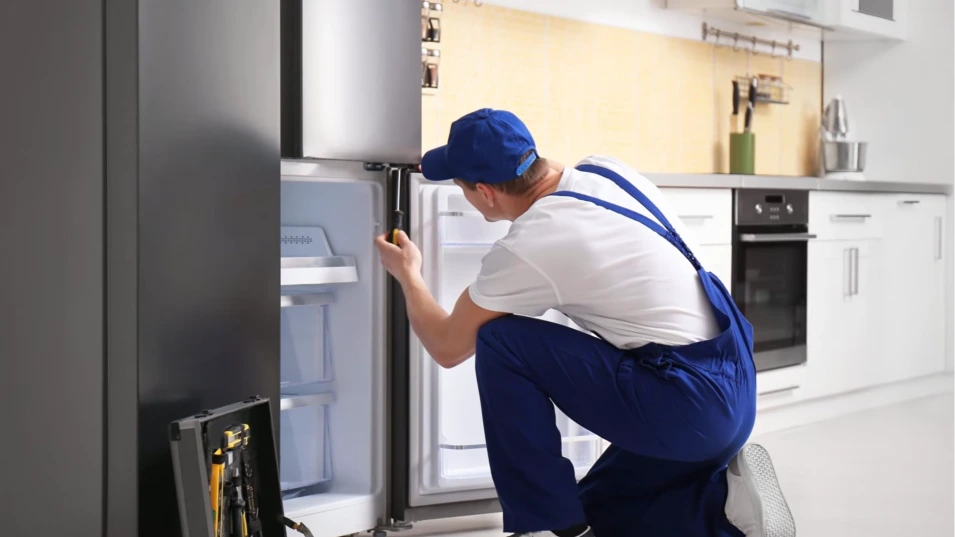
The most common causes, ranked by how often we see them — Spokane Refrigerator Grinding Noise
- Evaporator fan hitting ice buildup — the single most common cause, usually tied to a defrost system issue. Clearing the ice and addressing the cause runs $100–$200.
- Failing start relay — produces a loud click or buzz when the compressor tries to start. Replacement runs $100–$180.
- Worn condenser fan motor — a grinding or whirring noise from underneath or behind the unit. Runs $120–$220.
- Compressor nearing failure — a deep humming or knocking sound, confirmed with an amperage test rather than by sound alone. Runs $300–$600.
- Loose or unbalanced item — not a part failure; a bottle or container vibrating against the cabinet wall. No repair needed.
A quick way to narrow it down — Grinding Noise Spokane
When diagnosing a refrigerator loud grinding noise Spokane call, we check the evaporator fan first — it’s responsible for roughly 60% of unusual fridge sounds. Open the freezer and listen near the back wall, where the evaporator fan sits behind a panel. If the noise gets louder or changes pitch when the door is open, that strongly points to the fan and ice buildup rather than the compressor, which runs continuously regardless of the door. A grinding sound that stops as soon as you open the door is one of the clearest signs we see.
Is a loud refrigerator noise an emergency? — Spokane Grinding Noise Guide
Usually not immediately, but it’s worth addressing within a few days. A fan grinding against ice can eventually damage the fan blade or motor, turning a simple defrost fix into a more expensive fan replacement, and a failing start relay can sometimes prevent the compressor from starting at all without warning.
How much does it cost to fix a noisy refrigerator? (Spokane Grinding Noise)
Most repairs for this symptom run $90 to $250, covering a defrost system fix, fan motor, or start relay. A confirmed compressor issue runs higher, typically $300 to $600 including labor.
Same-Day Refrigerator Repair in Spokane
If your fridge is making strange noises today, we can usually get to you the same day. Call (509) 348-5757 or see our full refrigerator repair Spokane service overview, pricing, and service area.
Which Brands Develop Grinding Noises Most Often Often?
Grinding and fan noise patterns differ by brand — because the underlying designs differ. Knowing which brand you have narrows the diagnosis before a technician arrives.
Samsung
Samsung refrigerators commonly develop evaporator fan icing in the French-door models — the fan blade clips the ice buildup behind the freezer wall and produces a loud grinding or scraping sound. Samsung also issued a technical service bulletin acknowledging ice accumulation inside the ice maker housing that can cause a grinding noise as the auger tries to push ice through a frozen path. Both are distinct from compressor noise and are significantly cheaper to fix.
LG
LG refrigerators most often develop a clicking noise at startup rather than a continuous grind — the failed linear compressor tries to start, the relay trips, and you hear a click followed by silence. A continuous buzzing or humming on an LG that won’t cool points to the same compressor issue. Grinding specifically on an LG is more commonly the evaporator fan hitting ice, identical to the Samsung pattern.
Whirlpool
Whirlpool side-by-side and French-door models develop condenser fan noise as the most distinctive grinding pattern — the condenser fan is on the bottom rear of the unit and collects debris more readily than rear-mount designs. A grinding or rattling from the back bottom of a Whirlpool is almost always the condenser fan motor or a piece of debris caught in the fan blade, not the compressor. This is a $100–$180 repair.
GE
GE refrigerators — particularly older top-freezer and side-by-side models common in Spokane’s housing stock — develop evaporator fan motor noise as a bearing fails. The noise is a high-pitched squeal or grind that gets louder over weeks before the motor fails entirely. On pre-2010 GE units, the evaporator fan motor is a straightforward replacement: $100–$160 for parts and labor.
Frigidaire
Frigidaire models most commonly develop a rattling or vibrating noise from the drain pan underneath the unit — the pan sits loose on some configurations and vibrates against the compressor housing during normal operation. It sounds alarming but is often a free fix: repositioning or securing the drain pan. Frigidaire evaporator fan noise follows the same ice-buildup pattern as Samsung and LG.
KitchenAid
KitchenAid refrigerators share platforms with Whirlpool (same parent company) and develop similar condenser fan and evaporator fan issues. KitchenAid’s counter-depth French-door models have less clearance behind the unit, which means the condenser fan collects lint and debris faster — annual condenser cleaning is more important on these models than on standard-depth units.
When to Call for Repair vs. When to Wait
Not every refrigerator noise is an emergency, but some indicate a failure that will get significantly more expensive if left alone.
- Call same day: grinding or clicking followed by the fridge not cooling — this is a compressor or sealed system issue and food safety is at risk within four hours.
- Call within a few days: fan grinding against ice — the unit is still cooling but the fan motor will burn out if the ice isn’t cleared. A $150 defrost repair now prevents a $180 motor replacement later.
- Can monitor briefly: rattling from the drain pan or water lines — these are typically not damaging and can wait for a scheduled visit.
- Do not ignore: clicking at startup on an LG or Samsung — this is the compressor relay failing, and running the unit through repeated failed start cycles stresses the compressor itself.
What to Tell Us When You Call
The more precisely you can describe the noise, the faster we can diagnose it. Before you call, note: where the sound is coming from (front, back, inside the freezer, underneath); when it happens (at startup, constantly, only when the door is open or closed); whether the fridge is still cooling normally; and your brand and approximate age of the unit. This takes 30 seconds and often saves a return trip for a part we could have brought on the first call.
A grinding noise often appears alongside refrigerator not cooling — when the evaporator fan fails, cold air stops circulating. If the fridge is also running constantly, dirty condenser coils are likely the root cause of both symptoms.
The EPA’s refrigerant regulations page covers what’s involved if your grinding noise is linked to a refrigerant leak and a compressor seal failure.
Common Questions
My fridge is making a clicking sound but still cooling — should I worry?
A single click when the compressor starts is normal. Rapid repeated clicking — especially if the fridge isn’t cooling properly — is the compressor trying to start and failing. Check the starter relay first (a $15 part). Shake it — if something rattles inside, it’s failed. If a new relay doesn’t fix it, the compressor needs attention.
How do I know if the noise is serious or just normal fridge sounds?
Location tells you everything. Back of the unit = condenser fan or compressor. Inside the freezer = evaporator fan. Underneath = drain pan vibrating. A new grinding or rattling that wasn’t there before is worth diagnosing — fan motors fail progressively and often take other components with them if left running damaged.
Most grinding noise issues we see in Spokane are fixable in a single visit — call Evergreen Appliance Repair and we’ll diagnose it same day. Fan motors, condenser fan blades, and evaporator fan ice buildup are all same-day repairs when we carry the part on the truck.
Frequently Asked Questions
-
Why does my refrigerator stop making noise when I open the door?
Because the evaporator fan shuts off automatically when the door is opened — it’s a safety and efficiency feature on almost every refrigerator. If the grinding or rattling stops the moment you open the freezer door, that’s confirmation the noise is coming from the evaporator fan, not the compressor. The compressor runs continuously regardless of door position. A noise that stops with the door open is a fan blade hitting ice buildup or a failing fan motor bearing — not a sealed system problem, and significantly cheaper to fix.
-
Is a grinding refrigerator dangerous?
Not immediately, but it depends on the source. A fan blade grinding against ice is not a safety risk — it’s a mechanical annoyance that will eventually burn out the fan motor if left alone. A compressor making a grinding or knocking sound at startup can indicate internal compressor damage, which carries a small risk of refrigerant leak over time. R600a refrigerant (used in most modern fridges) is mildly flammable in high concentrations, but the amount in a household refrigerator is well below the threshold that poses a fire risk in a normally ventilated kitchen. The noise is not an emergency, but it should be diagnosed within a few days before it causes secondary damage.
-
Can I keep using a noisy refrigerator?
Usually yes, for a short period — but with two important caveats. First, if the fridge is still holding temperature normally, the food safety risk is low. Check that both the refrigerator and freezer are at their correct temperatures (37°F and 0°F respectively). Second, ignoring a fan grinding against ice will eventually burn out the fan motor — turning a $150 defrost repair into a $150 defrost repair plus a $180 fan motor replacement. If the fridge is still cooling and the noise is fan-related, you have a few days to a week before secondary damage occurs. If the fridge is not cooling properly alongside the noise, treat it as same-day.
-
How much does a refrigerator fan motor cost to replace in Spokane?
A refrigerator fan motor replacement in Spokane typically costs $100–$180 for parts and labor combined. The evaporator fan motor (inside the freezer, behind the back wall panel) is the most commonly replaced fan and runs $100–$160 on most brands. The condenser fan motor (underneath or at the rear of the unit) runs $100–$180. OEM fan motors for Whirlpool, GE, and Samsung are stocked on our truck for most common configurations, so the repair is usually completed in a single visit of 45–60 minutes.
-
Will unplugging the refrigerator fix the grinding noise?
Temporarily — and only if the noise is from a fan blade hitting ice. Unplugging the refrigerator for 24–48 hours allows the ice buildup to melt, which stops the fan from hitting it and silences the grinding. However, this does not fix the underlying problem: the defrost system that should have melted that ice on a schedule has failed, and the ice will rebuild over the next 1–3 weeks until the noise returns. Unplugging also means your food is unrefrigerated for 24–48 hours, which creates a food safety issue. The correct fix is diagnosing which component in the defrost circuit failed — timer, heater, or thermostat — and replacing it. That’s a $150–$300 repair that permanently resolves the issue.