
Why Is My Refrigerator Not Cooling? Causes Explained — Spokane
A warm fridge is one of those problems where the clock is running the moment you notice it. Four hours is roughly what you have before perishables start becoming a food safety question. So before anything else — is the freezer still cold?
That one question tells you more than anything else about what’s actually wrong.
Freezer Cold, Fridge Warm — vs. Both Warm
If the freezer is still cold but the fridge section is warm, the refrigerant system is working. The problem is airflow — cold air is being produced but not reaching the fresh food section. This is almost always one of two things: the evaporator fan has failed, or the damper between the two compartments is stuck closed. Both are straightforward repairs.
If both are warm, the cooling system itself has a problem. Compressor, refrigerant, or a major electrical failure. More serious, and more expensive to diagnose.
If temperatures are fluctuating — sometimes cold, sometimes not — the system is working but cycling incorrectly. Usually a thermistor, a defrost issue, or a control board.
The Seven Causes — In Order of How Often We See Them
1. Dirty condenser coils
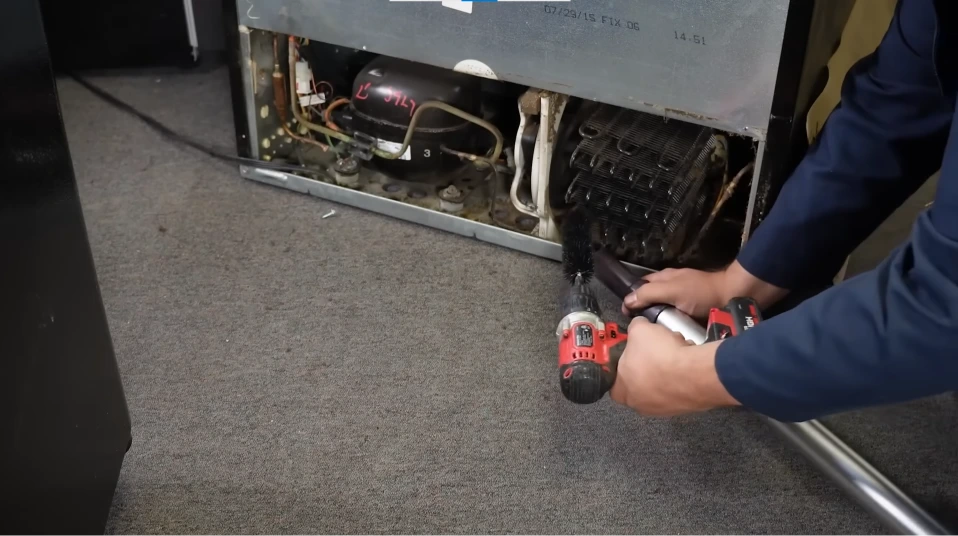
About a third of the “fridge not cooling” calls we get in Spokane come down to this. Condenser coils are at the back or underneath the refrigerator, and they’re how the refrigerant releases heat. When they’re coated in dust and pet hair, heat can’t escape properly — the compressor works harder, runs hotter, and eventually the fridge can’t hold temperature.
In Spokane specifically: wildfire smoke seasons introduce fine particulate into homes at elevated rates. We’ve seen coils here accumulate a year’s worth of buildup in six weeks during a heavy smoke event. If you haven’t cleaned yours and there’s been a bad fire season recently, that’s the first thing to check.
Pull the fridge away from the wall and vacuum the coils. If that doesn’t restore cooling within a few hours, the buildup has likely already caused secondary damage and you need a tech.
2. Evaporator fan motor failure
The evaporator fan sits inside the freezer compartment and pushes cold air from the evaporator coil into both sections. When the motor fails, the freezer stays cold because it’s right next to the coil — but no air moves into the fridge.
Open the freezer and listen. Fan running? Good — that’s not the problem. Quiet, or you hear grinding? Likely the motor. Most models let you confirm this by pressing the door switch while the door is open — the fan should run. If it doesn’t, the motor has failed.
Repair cost: typically $160–$260 all in. One of the simpler refrigerator repairs.
3. Defrost system failure
Every refrigerator runs a defrost cycle every 8–12 hours to melt frost off the evaporator coil. When the defrost heater, thermostat, or timer fails, frost accumulates over days until the coil is completely encased in ice. Airflow stops. The fridge warms up. The freezer may still have some cold since it’s closest to the coil, but it’s going too.
The tell: remove the back panel inside the freezer. If you find the evaporator coil buried in a solid block of ice, you have a defrost failure.
Quick test you can do yourself: unplug the fridge, prop the doors open, let it thaw for 24 hours. If it cools normally after thawing, the defrost system failed. The coil is fine — it just can’t maintain itself.
Why this matters: a defrost failure caught early is a $130–$200 repair. Left for weeks, it causes the compressor to run constantly under load. That turns a $150 fix into a $700 decision about whether the fridge is worth saving. If yours is frosting over or running constantly, don’t wait.
4. Temperature sensor (thermistor) failure
The thermistor reads the temperature inside and reports to the control board. The board uses it to decide when to run the compressor and when to stop. A failed thermistor sends wrong readings — the board thinks the fridge is already cold, so it never runs the compressor.
Symptom: the fridge is sometimes cold, sometimes not. Temperature inconsistency. The display may show a temperature that doesn’t match reality. More common in Samsung and LG models.
Repair cost: $110–$180. Relatively inexpensive because the part is small.
5. Air damper stuck closed
The damper is a flap between the freezer and fresh food sections that controls how much cold air flows through. Stuck closed: fridge warms up, freezer stays fine. Stuck open: fridge gets too cold and starts freezing food.
If the freezer is working, the fan is running, and the fridge is still warm — the damper is a strong candidate. Most common in French-door refrigerators. Repair cost: $150–$220.
6. Refrigerant leak
Less common than the above, but when it happens it’s serious. A leak means the refrigerant level drops, cooling capacity drops with it, and eventually the compressor runs dry and fails.
Symptoms: both fridge and freezer gradually get warmer over days or weeks — not suddenly, but slowly. Compressor runs constantly. Back of the fridge is very warm. You may hear rapid on-off cycling as the compressor tries to compensate.
Refrigerant handling requires EPA 608 certification. Not a DIY repair. Repair cost: $300–$600 depending on leak location, refrigerant type, and how much ran time without adequate charge.
Spokane factor: refrigerant leaks are more common in older units and in refrigerators stored in garages, where temperature extremes stress the tubing connections over years.
7. Compressor failure
The least common cause of “fridge not cooling” — but the most expensive. When the compressor fails, nothing cools. Both sections go warm. The compressor is silent (a running compressor makes a low hum). You may hear clicking as it tries to start and can’t. The sides and back of the fridge may actually be cool, because with no refrigerant moving, no heat is being rejected there.
Compressor failure is usually preceded by years of running hot from dirty coils, or damage from a defrost failure that wasn’t caught. Repair cost: $450–$800. On a fridge under 6 years old, usually worth it. Over 8–10 years, usually not.
LG note: French-door models from approximately 2016–2021 have a documented linear compressor failure pattern. LG extended the sealed system warranty to 10 years on many of these models. If you have one, check whether it qualifies before paying for a compressor replacement out of pocket.
What to Do With Your Food Right Now
Keep the door closed as much as possible — a closed fridge stays colder longer. Move meat, poultry, dairy, and leftovers to the freezer if it’s still working, or into a cooler with ice.
The FDA’s rule is simple: above 40°F for more than 2 hours, perishables are unsafe. Condiments, hard cheeses, whole fruits and vegetables can tolerate 4–6 hours. When in doubt, throw it out. Food poisoning from improperly stored meat is not worth whatever you’d save.
What a Tech Can Tell You in 20 Minutes That Would Take You Hours to Figure Out
The frustrating thing about a warm fridge is that six different failed components can produce the same symptom. Replacing parts based on what seems most likely is how a $150 repair becomes $400 — you bought a part you didn’t need and the fridge is still broken.
A proper diagnosis with the right tools — multimeter, temperature probes, refrigerant gauges — identifies the actual failed component. From there the repair decision is straightforward: here’s what broke, here’s what it costs to fix, here’s whether that makes sense given the fridge’s age.
Common Questions — Why Is My Refrigerator Not Cooling?
My freezer is cold but the fridge is warm — what does that mean?
Good news — it means the sealed system is working. Cold freezer + warm fridge is almost always an airflow problem: a failed evaporator fan motor, a stuck damper, or a frosted-over evaporator coil. These are $120–$220 repairs in most cases. Much less serious than a compressor failure.
Both the fridge and freezer are warm — is it the compressor?
Not necessarily. If you hear a clicking sound at the back of the fridge, it’s often a failed start relay — a $15–$25 part. If the compressor isn’t starting at all and there’s no click, then yes, compressor or sealed system failure is more likely. A proper diagnosis with a multimeter will tell you within minutes.
My fridge stopped cooling after a power outage — is it broken?
Power surges can trip the thermal overload on the compressor. Unplug the fridge for 30 minutes, then plug it back in. If it starts cooling again, the surge tripped the overload and it reset. If it doesn’t restart, the compressor or control board may have been damaged by the surge — worth a diagnostic visit at that point.
How long can I wait before calling a repair tech?
If food is at risk, not long — a refrigerator above 40°F is in the danger zone within 4 hours. Keep the door closed as much as possible. Move meat, dairy, and leftovers to a cooler or secondary fridge immediately. Call for same-day service if you can.
If you’re seeing other symptoms beyond no cooling — and want to check food safety guidelines — the FDA’s refrigerator food safety guidance is worth a read. If you’re seeing other symptoms beyond no cooling — the unit running constantly, unusual sounds, or frost in the wrong places — those are early warning signs worth knowing. If your fridge has been warm for more than 4 hours and cleaning the condenser coils didn’t fix it, call us at (509) 348-5757 — or see how our same-day Spokane fridge diagnosis works before booking. Same-day service for most Spokane calls before noon. For food safety after a warm fridge, see the USDA FoodKeeper guide. We carry OEM parts for Samsung, LG, Whirlpool, GE, and Maytag and give you a firm quote before starting anything.